Class 3/4 Decimals, Fractions, Percentages Revision (T. Lovell-Holligan)

Section A- Fractions 

Convert to Improper Fractions:


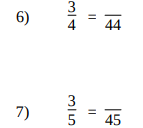
Find the equivalent fractions:


Reduce these fractions. 


Find the LCM of the given numbers: 

11.         16 and 20

12.        8 and 20


13-16. Add or Subtract. Remember to write as a mixed number and reduce when possible. 


SECTION B- DECIMALS

Write these numbers:

1. Twenty-nine hundredths

2. Eighty-one thousandths

3. Nine thousand thirty-four and seven-tenths

4. One and four thousandths

5. One hundred and sixty-two thousandths 

6. Forty-five hundredths

7. Four thousand three hundred twenty-one ten-thousandths 

8. One hundred twenty and five-tenths

 
Change the following fractions and mixed numbers to decimal numbers. Round answers to the nearest thousandth, if necessary. 


Change the following decimal numbers to fractions or mixed numbers. Reduce answers, if possible.

13)     0.2             14)     0.625                     15)     0.1875


Multiply (Class 4's Only)


16)        2. 1 x 0.09        17)     35.1 x 0.8            18)    3.05 x 1.3


Section C- Percentages


1. What is 30% of 840?

2. Find 25% of 4 metres? 

3. A backpack costs $580. A pencil case costs 15% lessWhat is the cost of the pencil case?

4. James wants to buy a laptop which costs $1250. He only has 25% of the money. 
    a. How much money does he have?
    b. How much more money does he need to buy the laptop?

5.  Dominic has saved $800 but Jay has saved 38% more. How much money does Jay have?

6. What number is 13% less than 2500?


Comments

Popular posts from this blog

CSEC English Mixed Revision Exercises (March 12, 2022)

  English Language Review Section 1: Poetry & Figurative Devices Simile - a comparison using like or as She was as quiet as a mouse when the police questioned her. Metaphor - a comparison without using like or as My grandmother is my heart. Personification - comparing an inanimate object to a human (e.g) It felt like the pizza was calling my name 4.  Hyperbole - an extreme exaggeration (e.g) I was so hungry I could eat a horse!  Read the lines of poetry. Figure out which technique is being used: simile, metaphor, hyperbole, or personification. Your beauty was a web of frail delight.  (    )  Now that I am without you, all is desolate. (    )  I could grow very still Like an old stone on a hill (   ) Your kiss lies on my face Like the first snow (   ) Section 2: Synonyms Choose the correct synonym to replace the underlined word.  1. The front page article reported that the senator suffered a serious injury in the car c...

Online Homeschool

  Tests & Assignments this week:  1. Vocabulary test 2. Group presentation Write the meanings below. Brevity- using few words Amiable- to be lovable, sweet-tempered, or kind Amiss- improper, wrong, or faulty Chastise- to rebuke or reprimand severely; punish Detriment- state of being harmed or damaged Eccentric- unconventional or strange behavior Flagrant- obviously offensive Duress- force to do something by threatening Gingerly- with extreme care or caution. Hallowed- regarded as holy ******** Paraphrasing & Summarizing ******* This is an important area across all subjects. It avoids plagiarism.  Let’s look at using synonyms correctly to help paraphrase & summarise:  The United States, Germany, Japan and other industrial powers are being transformed from industrial economies to knowledge and information based service economies, whilst manufacturing has been moving to low wage countries . In a knowledge and information based economy, knowledge and inf...

CXC English 2023

                                        Persuasive Writing  Persuasion is the act or process of presenting arguments to move, motivate, or change your audience's mind.    Common Persuasive Techniques 1.Emotional Appeals: One persuasive technique is appealing to the audience’s emotions: Fears, desire to seem intelligent, need to protect their family, desire to fit in, etc.  2. Rhetorical Questions: Rhetorical questions are questions that do not require an answer Example: Do we want our children growing up in a world where they are threatened with violence on every street corner? 3. Repetition: By repeating letters, words and phrases the author can reinforce an argument and ensure that the point of view being made stays in an audience's mind. 4. Evidence: Statistics, expert opinions, research findings and anecdotal evidence. 5....